Money exchange while traveling
In the previous article about forex we had seen that the foreign currency exchange market is actually a decentralized market, with no central authority setting the price.
This means that there will always be those who will try to monetize on unsuspecting tourists, who will find themselves spending money unnecessarily, and from my experience, they are quite a lot.
Always avoid
The following places should be avoided at all costs because of the absurd
fees they charge to squeeze money out of tourists’ pockets.
Airport money exchanges
I was once on a trip with some people who really believed the "0% fees"
advertisement from an airport kiosk, and it didn’t seem true to me that
they were so uninformed: when I pointed it out to them, they even told me
I was being conspiratorial to say it was a false advertisement (lol).
Anyway, this scam is based on the fact that when a person arrives in a
new country, he doesn’t know where to go or what to do, so they exchange
their travel cash money at the first place they see.
A store inside the airport is very expensive to rent, considering the
income it carries, and so everyone SHOULD ask himself a couple of
questions about how they make money.
Assuming you want to exchange 1$ (USD) for a bogus currency
called FKE, which at that moment in the currency exchange market
is worth 0.5$.
If it’s truly a 0 commission exchange, with 1$ you expects to receive 2 FKE.
However, they say that at that time, for them, the exchange rate is
1$ for 1.5 FKE, and they charge you 0 commission on the exchange
using this conversion.
If, on the contrary, you have money left over at the end of the trip in the
same exact moment, the exchange will magically be reversed, and
for every 2.5 FKE you give them, they will give you 1$ back.
Technically the advertisement is correct, but they are referring
to the commission on the exchange rate they themselves proposed,
and the actual real fees (aka spread) in this example is 25%,
basically you’re giving them 1/4 of your money (!!!).
In reality, the exchange rate is usually worse "only" by 10 to 15%
which is still a very high commission.
The same thing applies to money exchanges near the road border
between two countries with different currencies, for those traveling by car.
Euronet ATMs
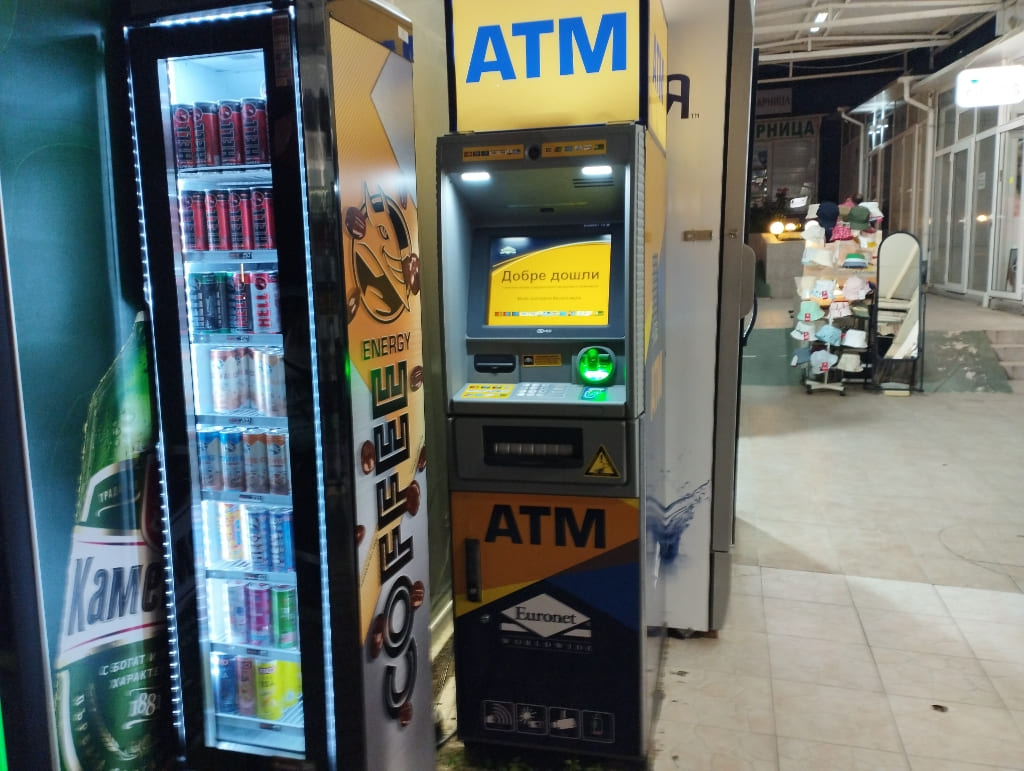 |
|---|
| Example of Russian ATM |
Euronet is an American company that places compact ATMs around
the world, but they have even higher fees than airports.
Pay attention to them the next time you walk around any city, they are
commonly found near tobacco shops, bars, restaurants, hotels, etc.,
and they pay a rent to the owner of the business in which they are housed.
These ATMs are a real cash cow for the company, usually charging a
fixed fee of 5 - 10€ per withdrawal + a mandatory % on currency
exchange of ~15%, billing your card for the € amount after this conversion.
Their target is usually those who go to a restaurant and find their card
declined (urgency) or perhaps those who simply want to get a small
amount of money and know nothing about what awaits them.
Options before traveling
OK, we’ve seen the options that should always be avoided.
Now let’s explore the options available before we even start our journey.
What can we do when we are still at home? Can we maybe sign up
for some card that will save us money?
Banks
Usually banks agree to sell you foreign currency at the market price,
in exchange for a fixed fee of about ~10€, which is very convenient
in the case of large amounts: if you change 100€, the commission is 10%,
but if you change 10,000, this is only 0.1%.
If you might be interested in such a service, you should start by
investigating about banks that offer this service in your area.
Brokers
If you have an account with an investment broker, it’s worth investigating
their currency exchange fees, since they could be very low.
In the case of Interactive Brokers,
one of the largest in the world, the commission is only 0.2 basis points,
which means 0.002% of the total, nothing in the rest of the list achieves a
commission that low.
However, if you use Interactive Brokers only for currency exchange operations,
after a while they will limit your account, and it’s therefore necessary to
have a real investment account and treat the exchange as only something minor.
To spend the converted amount after the exchange, you need to transfer
it to a bank account that supports the currency, and perhaps have a card
linked, so you can spend the money while traveling.
Since free bank transfers through the SEPA circuit only support
Euros (thank you, EU!), there may be a fee for moving money through
other bank transfer circuits (e.g. SWIFT).
Credit & debit cards
It’s possible to make payments with a regular card abroad, however,
there are fees to consider.
Mastercard and Visa offer a currency exchange service to card-issuing
banks, and basically all of them use it.
In the case of Mastercard, there is a website
where we can see the exchange rate they apply.
Taking the Euro - Polish zloty exchange rate of the previous day as
an example (the website is updated only once a day),
we can see that while the current exchange rate listed on XE.com is
1€ = 4.343zł, the exchange rate provided by Mastercard is 4.327zł.
Basically, when we need to spend the same amount of zł,
with the Mastercard conversion it costs us 0.35% more once we
convert the amount to Euros.
In addition to this, the bank charges its own commission of choice on the
currency exchange made with the card, usually around 3%, so the actual
final commission is about ~3.40% (including Mastercard exchange spread).
American Express cards are not that convenient either, they promote
themselves as ideal cards for travelers and then almost no one accepts them
(because they charge higher merchant fees) and on currency exchange
they charge a whopping 2.5%.
Card aggregators
There is a service, Curve, that gives you a physical card without its own
associated bank account, and this card forwards payments to another
existing Visa or Mastercard card issued from your bank.
The convenient part is that before forwarding them, Curve converts the
amount to be paid to the currency of the card, using the Mastercard
exchange rate, without any fee added.
So if your bank applies the Mastercard + 3% exchange rate, using this
aggregator service will save you the 3% (but, as we have seen, the
Mastercard exchange rate is slightly worse than the current one, so the
0.3 / 0.4% fee, aka spread, is present anyway).
Travel debit cards
There are some debit cards designed specifically for travelers,
including Wise and Revolut, which don't use the currency exchange rate
provided by Visa or Mastercard but, instead, handle it themselves
and the conversion rates are generally slightly better.
Considering the current Euro - Polish zloty exchange rate (1€ = 4.33429 zł),
the 2 cards offer us respectively:
1€ =
Revolut   4.3240 zł  (-0.23%)
Wise        4,3340 zł  (-0.005%)
Both fees are lower than the exchange rate applied by Mastercard,
but right now, for this specific currency, the exchange rate applied by Wise
is really good, less than 0.01%, although they are both good options and
at certain times Revolut’s exchange rate might be the better one.
However, when you use Wise, they apply a "conversion fee" to offer
you the great exchange rate (usually 0.5% - 0.7%, 0.64%
for zloty) and, as a result, it’s less convenient in our example (0.23% vs 0.64%).
Local options
You are in the middle of your trip and need money in the local currency,
what are the possible options?
Pay directly with strong currency (when accepted)
If you go to some small Eastern European country, such as Bulgaria,
it may happen that when you go to the restaurant there are notices where
it’s specified that they also accept Euros directly, to accommodate tourists
who may not have changed their money.
A similar thing happens, for example, in some South American countries
with the Dollar, since it is perceived as safer.
However, it must be mentioned that the Bulgarian Lev - Euro exchange
rate has been stable in the last 10 years, and they are planning to adopt
Euro as well, so this certainly doesn't apply in every country you visit.
ATM Withdrawal
With services such as Wise or Revolut, you can make a certain number
of ATM withdrawals for free, using their exchange rate, which is
very convenient, as we have seen (it isn’t the Mastercard/Visa exchange rate).
However, the ATM from which you withdraw must be configured to not
charge fees on cards not belonging to that bank: if this is the case,
you will be notified when trying to withdraw.
You always have to get a good city walking tour before you find a
decent bank that doesn’t apply it, I always withdraw some cash (~10/20€)
because they can be useful.
From my experience, some of the foreign ATMs that do not charge withdrawal
fees are for example those of Banco Bradesco
in Brazil and Ardshinbank in Armenia.
Local banks
It’s always possible to go to a local bank in the cities you visit and get some
local currency cash, giving Euro banknotes or (sometimes) paying with your card,
using their exchange rate.
However, the exchange rate they charge is not the best compared
to other available options.
Street exchange
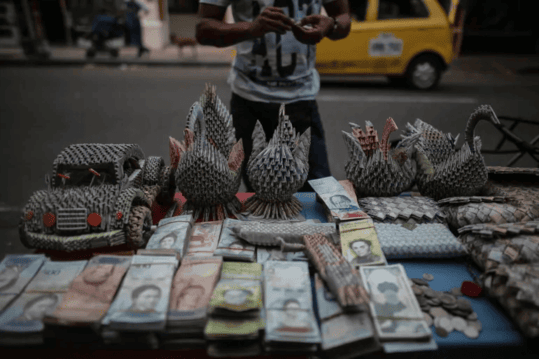 |
|---|
| Street Exchange in Venezuela |
Here I include only those countries where there is an unofficial exchange rate,
such as Argentina and Venezuela, where the local currency sucks so badly
that its citizens are willing to do anything to get rid of it in order to buy
foreign currency, which is considered more stable.
These countries printed more money than they could afford to do,
to repay their previous debts, and now they are paying the consequences.
If you pay using a credit card you will in fact have an exchange rate
hat is generally 30 / 40% worse (the official one) than you would have
by exchanging Euros or Dollars for local cash at these street exchanges,
which are basically people on the street with stacks of banknotes ready
to be exchanged.
Western Union
It’s possible to book a cash withdrawal a few days in advance (minimum 3)
at a Western Union point present in the country you are going tovisit,
convenient to safely obtain a large amount of cash, but with not
insignificant fees (5 - 10%).
Exchange kiosk
Here I am referring to the classic currency exchange stores around the city
that accept Euros in cash and give you the local currency.
You should definitely avoid those placed in the touristic area, as they
will ask for a spread on the exchange rate up to 10% (nice high commission, right?).
The best ones are in a suburban area frequented mostly by locals.
For Armenia there is a site that shows the exchange rates of each kiosk
in real time with its location, called rate.am,
I haven’t found any other country with something like this.
They can be really convenient for currencies of small countries
such as Armenia: at the time I am writing, the average exchange rate
on XE.com is 1€ = 405 ֏, cards like Revolut probably give you a
slightly worse exchange rate, around ~400 ֏.
On the kiosks listed on that site, they offer you an even better
exchange rate than the official one (currently 1€ = 408 ֏), keep this
option in mind.
However, you have to be careful to count the money right when they
give the cash to you, directly on the counter, without putting it in your
wallet immediately.
It’s common for them to accidentally "forget" to give you some banknotes,
so it’s always recommended to use the calculator before going there,
or there’s a 90% chance to get fooled because you are a tourist.
When you remark that a part of what you expected is missing,
immediately you will be given the rest, because otherwise they would
be on the wrong side.
However, if they still do this, it means that many people don't notice it,
and they have only to gain from it.
Emergency options
What can be done in case of emergency?
I once happened to find myself with all my cards blocked due to
movements considered suspicious by the bank and with not enough
cash at all to cover travel expenses.
Here’s what I did.
1
I immediately converted my emergency fund (50€ cash) to local currency
using one of the previously mentioned kiosks.
After all, this is the purpose of the emergency fund, which I recommend
to always have.
It should, however, be kept in a safe place and not in your wallet,
as you might also need it in the hypothetical event that you are robbed.
2
You can open an online bank account in minutes that doesn’t need a
physical card to be used, such as Revolut.
You sign up, get verified with your documents, transfer a few hundred
euros to your account IBAN and then use a virtual card linked to something
like Google Pay to pay contactless with your phone in the stores.
3
Ask for an emergency cash withdrawal using services such as Ria or
Xoom, quite similar to Western Union.
It will take 2 or 3 days, and you have to pay a quite high commission (~10%),
but if you have no alternative you are happy to pay them as long as
you get enough money for the trip.